
In the realm of academia and the vibrant world of debate, Jon Bruschke stands as a seasoned figure, having dedicated decades of his life as the debate coach at Cal State Fullerton.
His journey has been one of intellectual vigor, collaboration with remarkable students, and facing off against prestigious institutions like Harvard, USC, and Northwestern. The pinnacle of their success even found them on the front page of the Los Angeles Times.
Yet, amid the discussions of international policy, war strategy, political elections, and legal arguments, Bruschke sensed a need for something more—a personal touch, an infusion of the students’ own lives and identities into the debates.
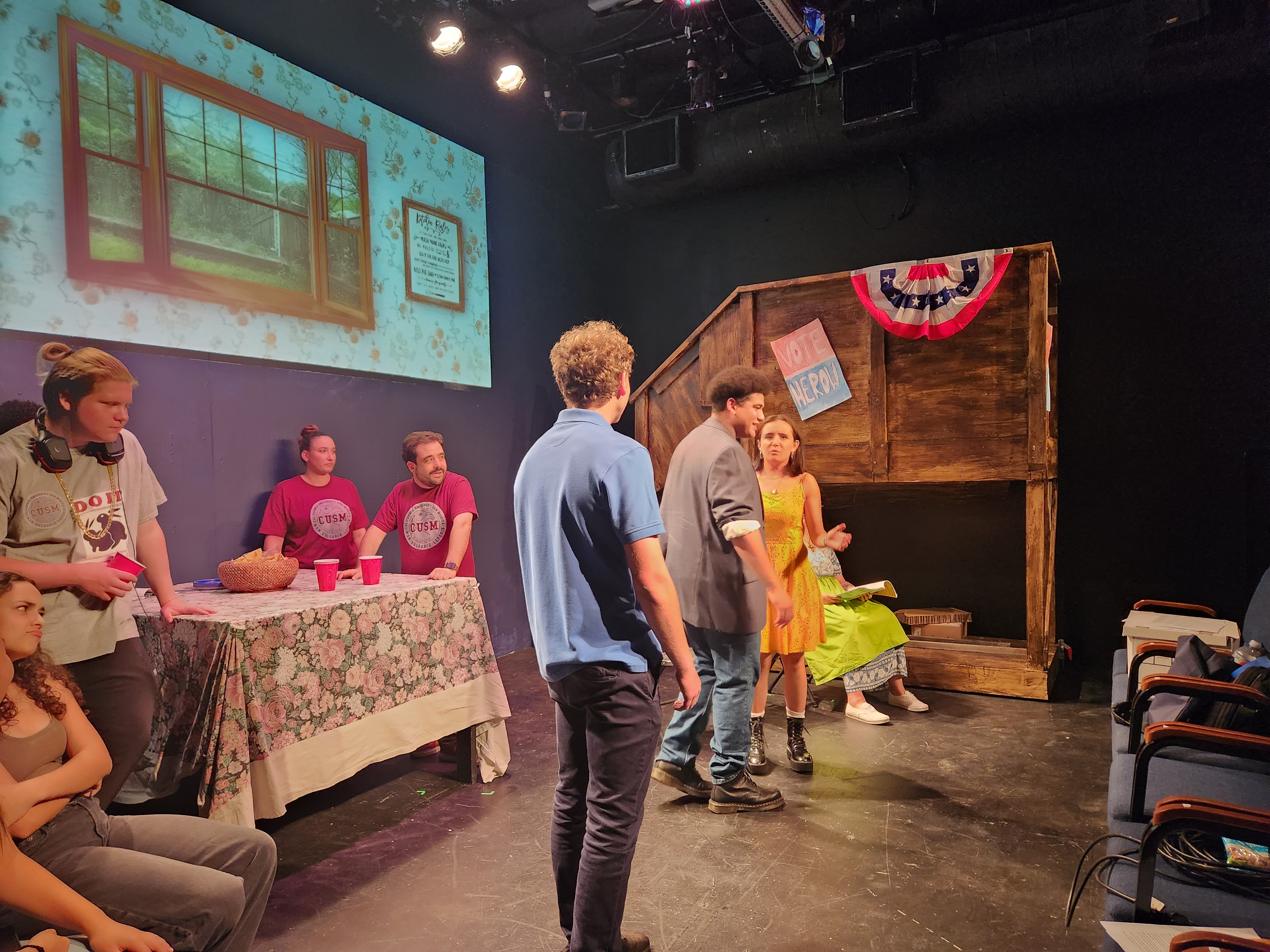
This remarkable journey in the dual realms of academia and music has culminated in Jon Bruschke’s latest creation, the musical “Change The Game.”
Set against the backdrop of Orange County, this musical is a testament to Bruschke’s belief in empowering young people to navigate the complexities of the current political environment with a fervent desire to make the world a better place.
Beyond the academic corridors, Bruschke’s passion extended to the raw and unfiltered world of music. As a member of the 3-chord garage rock band, True To the Universe, he collaborated with fellow CSUF professor and exceptionally skilled guitarist, Andrew Howat.
Can you walk us through your creative process in developing the storyline for “Change The Game” and how you integrated Orange County and political themes?
The most romantic version is that during March of 2020, early in the pandemic I had a dream about debate and music. I woke up, sketched out 3 pages of plot line, and sent it to Andrew. To my amazement, he didn’t recoil in horror but pointed out some major plot concerns. That 3 pages grew into a 12-page document which became an early script.
We did 2-3 table readings in the family living room and added songs and dialogue until Joe Hufferd’s Troy High school’s theater class did a table reading. After more revisions we did a table read with Hope International University’s theater group. We then had the basic storyline and Andrew and I finished the music and recorded all the tracks at his home studio.
In August 2022 we did a workshop performance at the Maverick, and with a few more tweaks we ran 4 performances at the Chance theater in August of 2023. With minor character tweaks essentially the same version of the play just finished at the Laguna Beach Cultural Arts Center in January of 2024.
How did the unique cultural and political landscape of Orange County influence the characters and overall narrative of the musical?
Orange County is still thought of as homogenous and Republican, maybe with some Latinx pockets, and maybe becoming a little more purple. But in my college classes, diversity was exploding with Thai, Vietnamese, Chinese, African American, Southeast Asian, and Latinx people, often from mixed races.
So my story about Orange County is how this second generation of Orange County immigrants comes to grips with their passionate desire to change the world for the better while coming together with hosts of people who have no demographic similarity to themselves.
In one of my last year’s of coaching debate, I looked around the room at my team and saw that I was the only native English speaker in the room. Two continental Indians, two Latinx students, an Iraqi and a distant member of the Kennedy clan (who spoke Japanese). But, although they had never met before joining our debate team they were fast (and now lifelong) friends.
This, to me, is the story of Orange County and diversity done right: Uniting a hugely different group of people around a common cause that improves them as people while looking for a way to improve the planet. And it worked.
Were there any specific elements of Orange County that you found particularly inspiring or challenging to incorporate into the story?
The goal was to identify both the elements of traditional homogeneity and housing-development culture AND the stories of the different ethnic pockets. The thing that really strikes me is that we’ve seen the story about what happens to a cohesive group of immigrant people trying to survive in a dominant, and traditionally white, culture.
What I wanted to do was ask: What happens when that second generation of folks from an array of different backgrounds, all partially Americanized, come together and try to figure out how to build a future for themselves and others? This is what was happening in my college classes every day, and it’s a point of view that really needs to be expressed.
The musical is designed to tackle political ideas while maintaining a fun atmosphere. How did you approach balancing humor and serious political themes in the writing process? Can you share any specific scenes or characters where this balance is particularly evident?
In the middle of the second act, the evil political operative (Bannon Miller, played by Milo Bruschke) and the aspiring young campaign manager (Channing Tomtro, played by Cameron Conner) sing a song called “Killer In His Eyes.”
In the story, the Governor has died in the Professor-Candidate’s office. To Miller, this just convinces him that maybe the candidate isn’t too soft after all. Neither Milo nor Cameron have much formal dance training, so they make the choreography out of big, gross motor moves.
The only way to play it is campy and they really killed it in Laguna Beach…it takes on the nastiest party of politics, plays it as a joke, and when it’s done the audience is acutely aware who the bad guys are and what ideas have led them astray, but they arrived there after spending 4 minutes laughing hard at the song and the dancing.
How did you approach developing characters that are relatable and engaging for the audience?
My students—those on the CSUF speech and debate team—are the most engaging, lively, brilliant, friendly people I know. The characters in the script are all modeled after some of them — Brenda Erendira, the lead female role, is based on Brenda Montes, once the 4th speaker in the country and now the best immigration lawyer who ever lived. Other characters are composites, or are based on stories students have told me about their lives.
Add to that a cast that is filled with their own incredible life stories, and the combination is pure magic. The abuela character is based on the mother of Luis Andrade, one of my students. She is played by Julieta Morales, who was literally fleeing gang violence in Mexico while we were running our workshop at the Maverick.
Milo played Captain Hook against Brody Makua’s Peter Pan in the 5th grade; Brody developed POTS and is now heavily reliant on a wheelchair to move and missed 2 years of school. But, she brilliantly plays a joint student/reporter role and gets so much out of each line you don’t even notice she’s in the chair while performing…she’s just a cast member who happens to be in a wheelchair most of the time. I mean, if you can’t relate to these people, you just don’t like people.
The musical delves into political themes. Can you share your approach to incorporating political commentary into the narrative without becoming overly didactic?
Early on I latched onto the idea that the audience will spot you the first 10 minutes, so the opening scene is a lecture in the classroom. It introduces the ideas and some of the characters and the point is to set up the ideas, which aren’t intended to make sense all the way. The characters openly proclaim that they don’t get it.
The idea is to introduce some rather difficult, high-end philosophy concepts so that they are named in the opening scene, and then the action for the next 2 hours demonstrates through jokes, dancing and music what the ideas mean. If it goes well, when the Brenda and Channing character split in the last scene over differences in how to empower a community, it’s a natural outgrowth of the action and relationships that have developed to that point in the show.
Were there specific real-world events that inspired or influenced the political aspects of the storyline?
When I was living in Placentia between 2000-2013, a developer named “TOD properties” came in with the plan to basically move out all the residents and put in higher-end housing. Very heavy-handed gentrification.
The tiny city hired the most expensive lobbyist in California to make the project happen, and my wife and I attended a city council meeting at the local high school. All these local and largely Latinx residents were there and angry, the polished Berkeley-grad mayor showed up with a developer, financier, and zone planning expert.
It was a true clash of privilege against marginalization, and there was no doubt the rich guys though they’d have no trouble moving out the poor people. The poor people totally knew the score and were there to speak up against the powerful.
Whenever I think of Pedagogy of the Oppressed, that moment really brought the ideas to life for me. The people won that round – the whole project collapsed in a heap of corruption and broken promises and the development never happened.
Are there moments or messages within the musical that you believe will resonate strongly with viewers?
There is a moment when the Professor realizes that, although he’s been put forward as the candidate, the real leaders need to be the students. The song is “Moment of Clarity” and the cast tells me its one of the better songs. Miles Henry really, really sells a middle-aged man coming to grips with his purpose in life.
Not to give too much away, but Abulea passes away during the second act. This is visually demonstrated when a memorial picture is placed on a tripod at a funeral home, and there are audible groans of sorrow from the audience when the picture is placed for the first time.
The finale song – “Change the Game” – has a terrific build and when the all-cast vocals come together and the final chorus is really punched, it gets a standing ovation.
The overall question of the show is how can young and idealistic people survive and make any difference in the current cesspool of national politics; the answer in the show – which was the answer for our debaters – is that you have to be in it to change the game for the better, not just in it to win it.
What impact do you hope “Change the Game” will have on the audience, both in terms of entertainment and political awareness?
The goal is to introduce high-end ideas about empowerment in a totally enjoyable medium; they should come away with a much deeper appreciation for why a philosopher can say “reality is a social construction” and that can have such a profound impact on one of the leading pedagogical theorists of the past century.
And they should do it while coming home with a smile and humming the songs to themselves in the shower the next day.
After the production of “Change the Game,” do you have any plans for future projects or aspirations for the musical’s continued success?
I’m not a professional theater guy – this isn’t a musical I tried to come up with, this is the story of the most meaningful parts of my life, integrated with my passion as a songwriter and garage-band enthusiast. But I can’t express in words how much I believe in this show, and this cast. My goal is to push this show as far as it can for as long as it has life and relevance.
For more information on “Change the Game,” visit: https://changethegamemusical.wordpress.com/
About The Author